Kosoba Ardia

Water reduction mechanism of 20 to 40% with EF Polymer

EF Polymer is a hydrogel that retains water close to the roots, limiting losses through infiltration and evaporation, thereby reducing water input by 20 to 40%, depending on crop types and soil conditions.

Loss reduction and gradual release

Reduced leaching and percolation: by retaining water in gel form, EF Polymer limits rapid infiltration beyond the root zone (leaching) and also reduces percolation and evaporation.

Soil moisture regulation

The polymer releases water only according to plant needs, i.e., when soil moisture decreases. Water is released slowly and progressively, ensuring regular and optimal hydration.

Reduced water stress

Thanks to this constant water availability, plants experience less water stress. It becomes possible to reduce irrigation frequency and/or volume. This optimization enables a proven reduction in water input of 20 to 25%, with potential savings of up to 40% depending on the type of crops.

The scientific mechanism (retention and release)

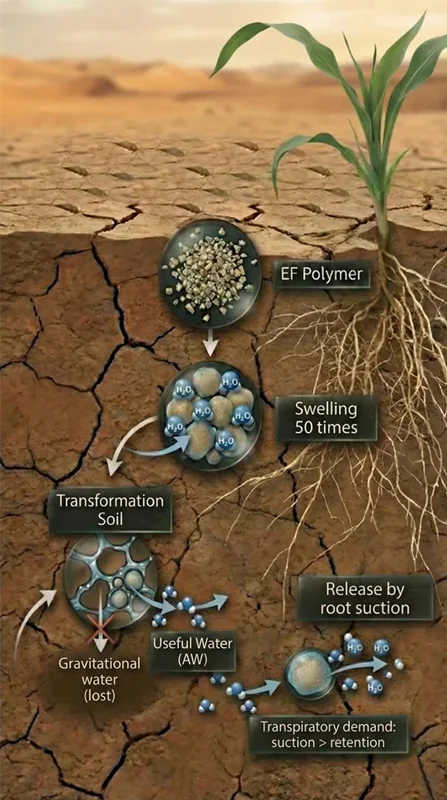
In sandy or sandy-loam soils of the Souss-Massa region, hydraulic conductivity is high. A large portion of irrigation water is lost through deep percolation (gravitational drainage) before plants can absorb it.

Osmotic hydro-retention mechanism

The cross-linked molecular structure of EF Polymer creates high osmotic pressure that attracts and traps water molecules (H₂O) within its matrix, swelling up to 50 times its dry weight.

Soil transformation

By integrating into the substrate, the polymer modifies the soil water retention curve (pF). It converts gravitational water (normally lost) into Plant Available Water (PAW).

Release through root suction

Water is not permanently sequestered. The polymer acts as a buffer reservoir. When the plant’s water potential decreases (transpirational demand), root suction becomes stronger than the polymer’s retention force, releasing water on demand.

Learn more about the benefits of EF Polymer

Significant additional yield

The use of the polymer optimizes water resource allocation, enabling the plant to redirect energy toward fruit production rather than root development, resulting in significant gains (e.g., for tomatoes: +46% marketable yield).

Up to 20% less fertilizer

By maintaining moisture in the root zone, EF Polymer improves nutrient availability. Fertilizer requirements are reduced by 20% without compromising crop performance.

100% biodegradable within 12 months

Unlike synthetic polymers, EF Polymer fully degrades in approximately one year, without microplastics or residues. It improves soil structure and organic matter, making it fully compatible with sustainable agriculture.